
Hubble Telescope Takes Incredible Pics of Mars

An amazing new Mars image captured by the Hubble Space Telescope shows clouds, craters, ice caps and other features on the Red Planet.


Hubble took the photo on May 12, when Mars was just 50 million miles (80 million kilometers) from Earth. That's quite close in the cosmic scheme of things; Mars is nearly at "opposition" — when the planet and the sun are on exact opposite sides of Earth from each other — which will come on May 22.

Opposition "marks the planet's closest approach to Earth, so that Mars appears bigger and brighter in the sky than usual," European Space Agency officials wrote today (May 19) in a description of the newly released photo. (The Hubble mission is run jointly by NASA and ESA). "This event allows astronomers using telescopes in space and on the ground to see more details on the Martian surface." [The 7 Biggest Mysteries of Mars]

The dates of closest approach and opposition don't mesh exactly. The closest approach will actually come on May 30, when Earth and Mars are separated by 46.8 million miles (75.3 million km).

The average time between Mars oppositions is about 780 days; the last time Earth, the Red Planet and the sun all lined up was in April 2014. And some closest approaches are closer than others. In 2003, for example, Mars came within 34.65 million miles (55.76 million km) of Earth — the closest the two planets had been in 60,000 years, ESA officials said.

The new Hubble photo, which the telescope took with its Wide Field Camera 3 instrument, shows a natural-color view of Mars in which mountains, plains, canyons, craters and many other geological features are visible.
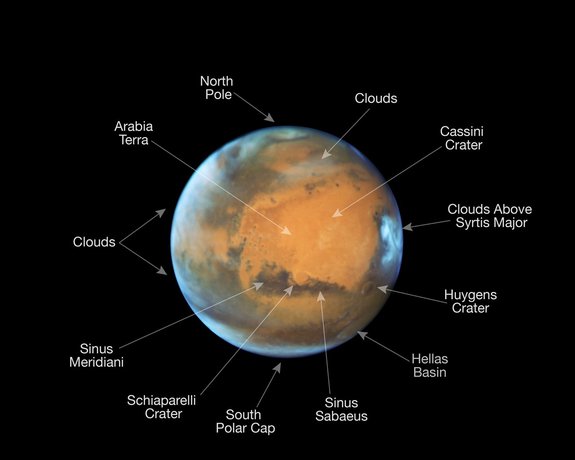
Annotated view of Mars as it was observed shortly before opposition in May 2016 by the NASA/ESA Hubble Space Telescope

"The orange area in the center of the image is Arabia Terra, a vast upland region," ESA officials wrote. "The landscape is densely cratered and heavily eroded, indicating that it could be among the oldest features on the planet."

"South of Arabia Terra, running east to west along the equator, are the long, dark features known as Sinus Sabaeus (to the east) and Sinus Meridiani (to the west)," they added. "These darker regions are covered by bedrock from ancient lava flows and other volcanic features."

Clouds blanket the dark volcanic plains of Syrtis Major, on the right side of Mars, and cover the extensive south polar ice cap as well. (The northern ice cap is quite small, because it's currently summer in Mars' northern hemisphere.)

Hubble launched in April 1990 aboard the space shuttle Discovery. Spacewalking astronauts repaired its flawed primary mirror in December 1993, and the famous telescope has been helping astronomers make big discoveries ever since. Barring any unforeseen events, Hubble should keep operating through at least 2020, and perhaps longer, NASA officials have said.

Source : Space

Comments

Popular posts from this blog

Zika Virus is Proved Causing Birth Defects

Officials at the Centers for Disease Control and Prevention has confirmed on Wednesday that there was now enough evidence to say that the Zika virus could cause unusually small heads and brain damage in infants born to infected mothers. A therapist teaching a mother in Recife, Brazil, last month how to massage her baby, who has microcephaly. The conclusion should settle months of debate about the connection between the infection and these birth defects, called microcephaly, as well as other neurological abnormalities, the officials said. “There is no longer any doubt that Zika causes microcephaly,” said Dr. Thomas R. Frieden, the C.D.C. director. He said the conclusion, reached after evaluating “mounting evidence from many studies,” signifies “an unprecedented association” in medicine. “Never before in history has there been a situation where a bite from a mosquito can result in a devastating malformation,” Dr. Frieden said. ...

Nigerian army Claims the Second Rescue of Chibok Girl

A second schoolgirl that was seized in the Nigerian town of Chibok has been found, the army says. But a spokesman for the Chibok girls' parents has cast doubt on the claims, saying that the girl's name is not on the families' list of those missing. An army spokesman said Serah Luka was among a group of 97 women and children rescued by troops in the north-east. Islamist militant group Boko Haram has abducted thousands of other girls in recent years, rights groups estimate. This comes two days after the rescue of the first Chibok girl, Amina Ali Nkeki. The army has previously given misleading statements about the rescue of the Chibok girls - in its initial statement after Ms Nkeki was found, it used a wrong name. In all, 218 girls remain missing after their abduction by the Boko Haram Islamist group from Chibok secondary school in north-eastern Nigeria in 2014. Ms Nkeki told a Chibok community leader that six of the kidnapped girls had died, but...

Will Ferrell and His Bird Collectian As "The Birds are for God"

An acclaimed actor and comedic genius like Will Ferrell is incredibly pleased to spend some valued time with his incredibly expensive bird collection, according to his good friend Adam McKay. McKay, who has directed Ferrell in films like "Anchorman" and "Step Brothers," told HuffPost Live on Monday that Ferrell's home is brimming with birds of all kinds, and Ferrell himself is a bit of a bird whisperer. "He has giant cages on his property filled with different tropical birds, and these are the kind of birds that will bite you, that you have to be careful with, but when it's him, they just fly right to his arm," McKay said. "Often times if you're at his house ... he has, like, a cockatiel on his shoulder for long stretches." An affinity for birds isn't exactly surprising, but what will shock you is the enormous monetary value of Ferrell's flock. "He had to have his bird collection insured, and I think it's wor...